

Quantum Readiness Scoring & Reports.
QuScor tackles Quantum Readiness Reporting ahead of regulatory deadlines, audit, or insurance requests — so you're ready to meet the new quantum standards of tomorrow.
From intake to audit-ready report.
One structured engagement, four steps, no PQC architecture deep-dive required on your end.
Intake Questionnaire
You complete a guided cryptographic-posture questionnaire covering inventory, custody, vendors, and monitoring.
Scoring & Gap Analysis
Answers are scored against a weighted readiness model, calibrated to your sector — custodian, defense, or general.
Report Delivery
You receive four documents: a full comprehensive findings report, a board-ready executive summary, a management SWOT analysis with live regulatory threat context, and an auditor-facing technical summary.
Audit-Ready Documentation
Findings are mapped to SOC 2, NIST SP 800-171, and NIS2 language so your auditor or underwriter can use it directly.
Six scored categories, one readiness number.
Weighted differently depending on whether you're a digital-asset custodian, a defense contractor, or neither.
Cryptographic Asset Inventory
Do you know where every key, cert, and algorithm actually lives?
Algorithm Agility & Migration Plan
Can you move to ML-KEM / ML-DSA without a system rebuild?
Key Custody Architecture
How keys are generated, stored, rotated, and recovered — HSM or MPCMPC vs. HSMTwo different ways to protect a private key. An HSM is a dedicated physical device that holds keys without exposing raw key material. MPC splits a key into shares held by separate parties so no single party ever holds the whole key. Scored on its own merits — the two aren't interchangeable., each assessed on its own terms.
Harvest-Now-Decrypt-Later Exposure
What's being encrypted today that an adversary could store and break later.
Vendor / Third-Party Dependency
How exposed you are to a single vendor's PQC timeline.
Monitoring & Incident Readiness
Whether crypto drift and deprecated configs actually get flagged.
A Python-based scoring engine, not a checklist.
QuScor runs on a Python-native proprietary scoring engine built in-house by Owlpha Labs — the same engine behind every report, calibrated to your sector, current as of your assessment date.
Six-Category Weighted Model
Every engagement scores six fixed categories — cryptographic inventory, algorithm agilityCrypto-AgilityThe ability to swap cryptographic algorithms (e.g. RSA → ML-KEM) without a full system rebuild — the core capability regulators and insurers are starting to ask about directly., key custody architecture, harvest-now-decrypt-laterHarvest-Now-Decrypt-LaterAn attack pattern where adversaries record encrypted data today with the intent to decrypt it later once quantum computers are powerful enough to break current encryption. exposure, vendor dependency, and monitoring readiness — each on a 0–100 scale, rolled up through a weighted formula into a single Quantum Readiness ScoreQRSQuScor's proprietary 0–100 score summarizing an organization's cryptographic and post-quantum migration posture across six weighted categories..
Sector Calibration Overlays
The same six categories are reweighted through a sector overlay — custodian, defense / government contractor, or general enterprise — so a digital-asset custodian's SOC 2 exposure and a defense subcontractor's CNSA 2.0 timeline are scored against different priorities, not one generic rubric.
Live Regulatory Threat Context
Every report is generated against a curated regulatory deadline calendar — FIPS 140-2 sunset, CNSA 2.0, White House EO, NIST phase-out milestones — updated each assessment cycle. The SWOT and findings sections reflect the threat environment at the time of your engagement, not a static template written six months prior.
Evidence-Tiered Confidence
Findings carry an evidence tier — from self-attested questionnaire responses up through validated technical corroboration — so your auditor or underwriter can see exactly how much independent verification stands behind each number.
See the actual deliverable.
Every engagement produces four documents from the same scoring data — auto-generated by the QuScor engine from your intake, not templated by hand.

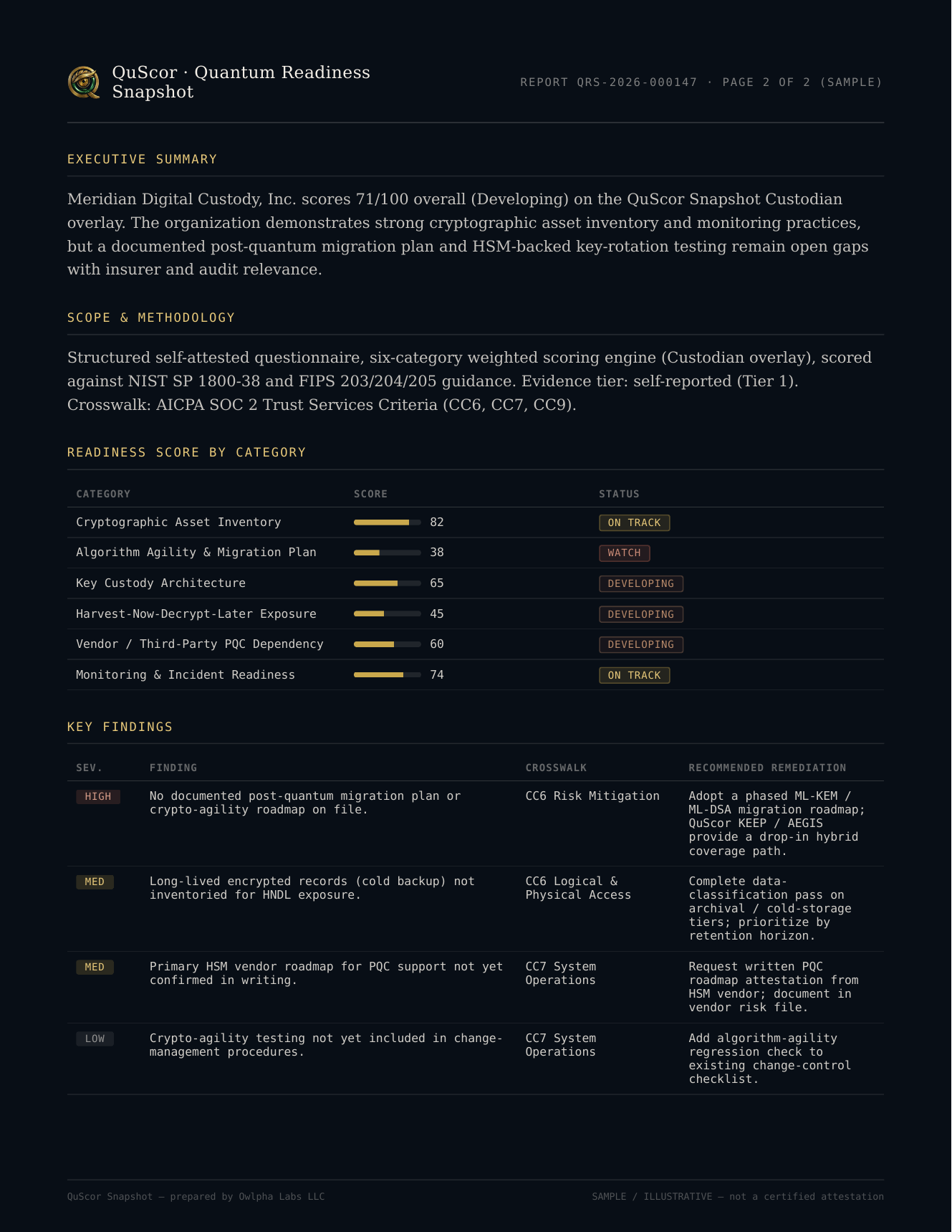
Comprehensive Report
Full per-question breakdown: every category scored, every gap surfaced with a finding and remediation action, NIST crosswalk, regulatory deadline calendar, and phased roadmap.
Executive Summary
Board-ready: the score, the band, and the three things leadership actually needs to act on.
Management SWOT Report
Strengths, weaknesses, opportunities, and a live quantum threat section — populated with current regulatory deadlines and active nation-state threat context at the time of your engagement.
Auditor Technical Summary
NIST standards reference table, 19-item evidence checklist, compliance crosswalk across SOC 2, ISO 27001, NIST CSF, DORA, and CNSA 2.0, and an assessor attestation block.
Built for the buyers already asking.
QuScor serves institutional buyers across four verticals — each with a distinct quantum readiness obligation taking shape now.
Quantum Readiness Reporting for Cyber Underwriters
Evertas, Bowhead, and specialist MGAs are adding quantum readiness to renewal questionnaires. QuScor delivers the scored, structured documentation your underwriter is asking for — before they ask.
CNSA 2.0CNSA 2.0The NSA's Commercial National Security Algorithm Suite — the required post-quantum algorithm set (ML-KEM, ML-DSA, AES-256) for national security systems, becoming a procurement gate January 1, 2027. Compliance Assessment
NSA CNSA 2.0 becomes a procurement gate January 1, 2027. QuScor maps your cryptographic posture to every CNSA 2.0 requirement — ML-KEM, ML-DSA, AES-256 — with an audit-ready findings report.
Post-Quantum Cryptography & SOC 2
SOC 2 reviewers are beginning to ask about cryptographic currency and migration planning. QuScor's Auditor Package is structured for SOC 2 evidence requirements — methodology reference, findings rationale, and compliance crosswalk included.
Quantum Readiness for Crypto Custodians
Harvest-now-decrypt-laterHarvest-Now-Decrypt-LaterAn attack pattern where adversaries record encrypted data today with the intent to decrypt it later once quantum computers are powerful enough to break current encryption. attacks target encrypted custody records today. QuScor assesses key management maturity, HSM infrastructure, and cryptographic migration status — across Bitcoin and multi-chain institutional holdings.
Quantum Readiness Reporting for Cyber Underwriters
QuScor delivers the scored, structured documentation that insurers and MGAs are beginning to require — before the renewal questionnaire arrives.
Cyber insurers are repricing quantum risk in real time — led by Lloyd's syndicates covering digital asset custody, who now ask about cryptographic posture on renewal forms. It's no longer whether your key management is quantum-resistant. It's whether you can prove it.
What insurers are asking: Are you running RSA or ECC for key exchange? Do you have a documented post-quantum migration plan? Have you assessed third-party cryptographic exposure? What's your timeline to ML-KEM or ML-DSA?
What QuScor delivers: A Quantum Readiness Score calibrated to financial-sector benchmarks, an Auditor Package built for insurer evidence review, and a SWOT Analysis mapped to current threat intelligence — from one 27-question intake, five-day turnaround.
CNSA 2.0 Compliance Assessment for Defense Contractors
The NSA's CNSA 2.0 framework stops being guidance and becomes a procurement gate on January 1, 2027. QuScor maps your posture against every requirement — with a report your contracting officer can read.
CNSS has mandated CNSA 2.0 migration for all national security systems — ML-KEM-1024, ML-DSA-87, and AES-256 required and preferred in network equipment by 2026, mandated across software and firmware by 2027.
What contractors need to demonstrate: Algorithm currency (are you running CNSA 2.0-approved algorithms?), key management maturity (lifecycle controls, HSM usage, rotation policy), a documented migration plan with timelines, and evidence of pilot deployments — typically a cryptographic bill of materials (CBOM) plus a migration plan.
What QuScor delivers: A CNSA 2.0-mapped assessment with a NIST standards reference table, a compliance crosswalk across CNSA 2.0 and NIST SP 800-208, and a 19-item evidence checklist built for contracting officer review — plus a scored Executive Summary program leadership can drop into a proposal.
QuScor doesn't replace a formal CMMC or DISA assessment — it produces the documentation that feeds into them, and surfaces gaps before a formal audit does.
Post-Quantum Cryptography and SOC 2
SOC 2 reviewers are beginning to ask about cryptographic currency and post-quantum migration planning. QuScor's Auditor Package is structured for SOC 2 evidence requirements.
SOC 2 Type II evaluates controls against the Trust Services Criteria, where cryptographic controls sit inside Logical and Physical Access, Change Management, and Risk Assessment. With NIST post-quantum standards finalized and CNSA 2.0 timelines public, auditors are starting to ask whether you've assessed crypto-agility and documented a migration path.
What SOC 2 auditors are beginning to ask: What algorithms are in use for data at rest and in transit? Is there a documented process for evaluating and updating cryptographic standards? Has the organization assessed exposure to harvest-now-decrypt-later attacks? Is there a post-quantum migration plan with assigned ownership and timelines?
What QuScor delivers for SOC 2 preparation: The Auditor Technical Summary includes a NIST standards reference table, a compliance crosswalk across SOC 2, ISO 27001, NIST CSF, and CNSA 2.0, and an assessor attestation block — a scored, sourced assessment in the evidence format auditors expect, not a narrative deck.
QuScor isn't a SOC 2 examination — it's the quantum-readiness documentation layer that feeds your SOC 2 evidence package, ahead of the questions your next auditor will ask.
Quantum Readiness Assessment for Digital Asset Custodians
Harvest-now-decrypt-later attacks target encrypted custody data today. QuScor assesses key management maturity, HSM infrastructure, and cryptographic migration status — across Bitcoin and multi-chain institutional holdings.
The quantum threat to digital asset custodians isn't hypothetical. Nation-state actors are recording encrypted key management traffic, custody signing records, and wallet access logs today, intending to decrypt them once quantum computing matures. The window for migration is open now — and closing.
What custodians need to assess: Are your key generation and encapsulation algorithms quantum-resistant? Do your HSMs (Thales, Entrust, AWS CloudHSM) support FIPS 203FIPS 203NIST's finalized standard for ML-KEM, the post-quantum key-encapsulation algorithm — the reference standard auditors and HSM vendors are building toward. / ML-KEM? Is your signing workflow compatible with a post-quantum key management layer? Have you documented your cryptographic exposure across all custody infrastructure — hot wallets, cold storage, MPC configurations?
What QuScor delivers for custody clients: A Quantum Readiness Score calibrated to digital asset custody — covering key lifecycle, HSM infrastructure, algorithm currency, vendor exposure, governance, and incident readiness — structured for three audiences at once: leadership (Executive Summary), compliance (Auditor Package), and the board or insurer (SWOT Analysis).
QuScor pairs naturally with QHelm, Owlpha Labs' post-quantum middleware for institutional custody. QuScor scores the gaps; QHelm closes them — assessment and remediation, together.
QPulse: proof, whenever you need it.
Your assessment gets you a score. QPulse keeps that score current — and provable — all year.
QPulse is an annual subscription, paid as a single upfront fee, that gives you timestamped, dated snapshots of your Quantum Readiness Score on demand — up to once per quarter — without redoing the full intake each time.
Proof exactly when it's asked for
A regulator, auditor, insurer, or opposing counsel doesn't wait for your next scheduled cycle. QPulse means you can generate a dated, defensible answer the same day.
One fee, up to four snapshots a year
Paid once, used as needed — up to quarterly — instead of paying for a brand-new engagement every time something material changes.
No repeat intake
A QPulse update carries your baseline forward and only asks about what's changed — new vendor, new mandate, new legal exposure.
- Guided intake questionnaire (27 questions, 6 categories)
- Comprehensive findings report (~15–20 pages)
- Board-ready Executive Summary
- Management SWOT Report with live regulatory threat context
- Auditor Technical Summary — NIST, SOC 2, ISO 27001, DORA, CNSA 2.0 mapped
- Custodian, Defense, or General Enterprise sector calibration
- 5 business day turnaround from completed intake
Built for the audit you already have to pass.
QuScor isn't a substitute for your SOC 2 examination or your CMMC assessment — it's the quantum-readiness documentation that feeds into them.
If a finding surfaces a serious harvest-now-decrypt-later or crypto-agility gap, we'll tell you — and what closing it would take.
The assessment fee is one-time and gets you your first score. QPulse is the optional annual subscription that keeps that score current and dated all year.
How this compares to a traditional engagement:
Questions we hear before every engagement.
What is a Quantum Readiness Score, and how is it calculated?+
The Quantum Readiness Score (QRS) is a 0–100 number from QuScor's proprietary scoring engine, built across six weighted categories — cryptographic asset inventory, algorithm agility, key custody architecture, HNDL exposure, vendor dependency, and monitoring readiness — reweighted by sector.
Do we need to already understand our cryptographic infrastructure?+
No. The guided intake is built for people who manage risk, not people who write cryptographic code. If a question needs technical input from IT or a vendor, we tell you exactly what to ask them.
How is QuScor different from a free self-assessment checklist?+
Free frameworks are a fine starting point, but they produce a checklist, not a dated, defensible artifact. QuScor's report includes a weighted score calibrated to your sector, an evidence tier on every finding, and documentation formatted for whoever's asking — auditor, insurer, or board.
Is QuScor a substitute for a SOC 2 examination or CMMC audit?+
No. QuScor produces the quantum-readiness documentation that feeds into a SOC 2, CMMC, or DORA evidence package — it surfaces gaps before a formal audit does, but it doesn't replace the audit itself.
What's the difference between Qalibration and the QPulse subscription?+
Qalibration is the initial engagement — the guided intake, your first scored report, and your baseline. QPulse is the optional annual subscription that lets you generate a new dated, timestamped snapshot of that score on demand, up to quarterly, without redoing the full intake.
How long does an assessment take?+
Most engagements run five business days from a completed intake to a delivered report.
Who actually reads a QuScor report — auditors, insurers, or our own team?+
All three, formatted differently for each. The Executive Summary is board-ready. The Auditor Package is structured for SOC 2, ISO 27001, and CMMC evidence review. The full findings report is for your internal technical and compliance team.
Most engagements start with a 20-minute scoping call.
No PQC architecture deep-dive required — just your current cryptographic posture, in your own words.